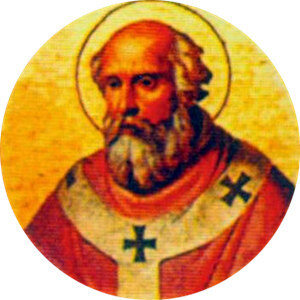

Who he was
Bruno, of a noble Alsatian family related to the emperors, was known at court as 'the good Bruno' and governed the poor frontier diocese of Toul for more than twenty years. Named pope by Henry III, he insisted on being freely accepted by the Romans and came to the city as a barefoot pilgrim, with Hildebrand at his side, in 1049.
What he is remembered for
He set the great reform of the eleventh century in motion, holding synods in Italy, Germany and France, notably at Reims in 1049, against simony and unchaste clergy, and travelled so widely that he was called the pilgrim pope. His war against the Normans ended in defeat at Civitate in 1053, and the mission he sent to Constantinople led, shortly after his death, to the break with the Eastern Church in 1054. His biographers tell of miracles in life and after death, and he is honoured as a saint in the Roman Martyrology.
He is honoured by the Church as Saint. Read his page in the dictionary of saints.
Sources
All popes · Home · All saints